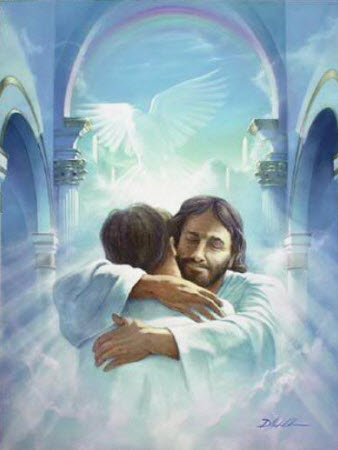

Know Who You Are

Do you know who you are? Do you have questions about what makes us human? Have you ever considered your makeup? Do you understand how thoughts move between each part of you?

This post is a 28-minute read.

Scripture tells us that we are composed of a Body, Soul, and Spirit. You may want to check out the “Why is God Invisible” page, too.

1 Thessalonians 5:23 says, “…May the God of peace Himself sanctify you entirely; and may your spirit and soul and body be preserved complete…”

This is the “theory of trichotomy”. Trichotomy means “division into three parts, elements, or classes”. The theory breaks the human being down into three distinct parts: body, soul, and spirit.

The physical body consists of the skeleton, muscles, skin, internal organs, the brain, and everything else that supports life.

Zechariah 12:1 says: “Thus declares the Lord, who stretched out the heavens and founded the earth and formed the spirit of man within him…”

This verse indicates that the whole, complete human being has a spirit formed within them. Our bodies house our spirits. We are, in fact, spiritual beings temporarily housed in a physical body. More on this below.

1 Corinthians 6:19-20 says: “…Do you not know that your body is a temple of the Holy Spirit who is in you, whom you have from God, and that you are not your own? For you have been bought with a price: therefore glorify God in your body.

The passage above indicates that the human body can also house God’s Holy Spirit.

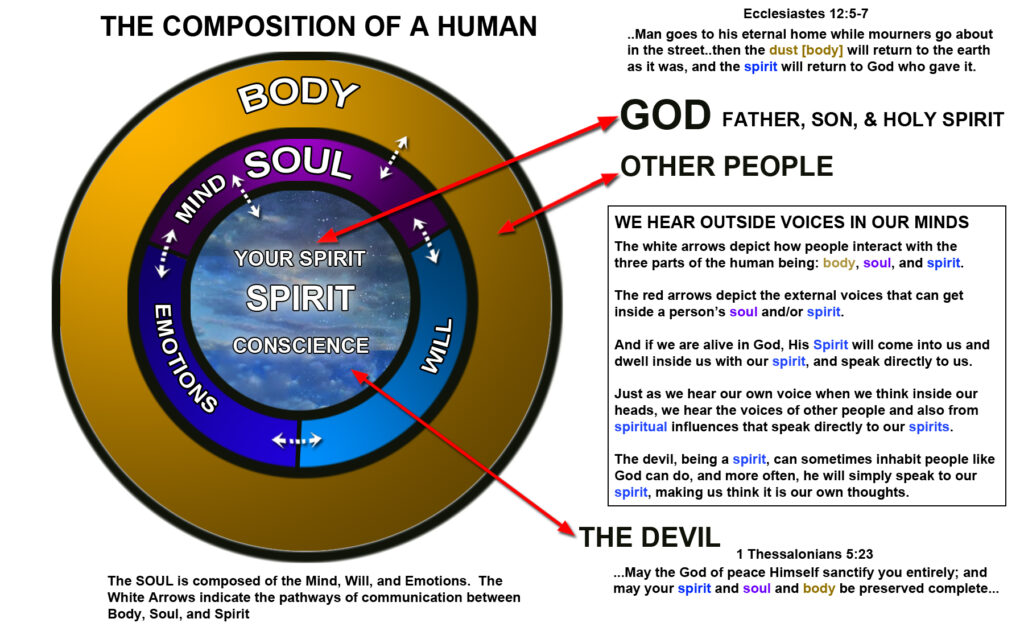
In the diagram above, the outer circle (gold) represents our physical body. The innermost circle (represented by the heavens) is the core or heart of us and represents our spirit being. When a Christian says “heart and mind,” they mean the mind and spirit. The soul and spirit are connected.

Notice also that a middle ring labeled “Soul” lies between the Body and Spirit. The mind, will, and emotions make up the soul. It has no body and is therefore not material. It is the active, yet non-material part of us that we can detect. We can only touch it through what we “feel” physically, our interactions with others, or our interactions with our spirits.

We store information from either our bodies or our spirits in our minds, wills, or emotions. Information flows into our minds, wills, and emotions within our souls. Information flows into our bodies from our souls. For example, the soul experiences grief, which manifests in our physical bodies as crying and tears. We can also feel grief in our spirit. For example, thoughts in our minds can enter our spirits as prayers to help us deal with grief.

Your spirit has your conscience. Conscience is “the sense of the moral goodness or worthiness of one’s own conduct and intentions.” The desire to do right and be good is in the conscience.

Of course, if you’re not following God’s teaching and commands, your sense of these things is subjective.

Your conscience can be deprogrammed and reprogrammed to take on a different nature.

1 Timothy 4:1-2 says: “...The Spirit explicitly says that in later times some will fall away from the faith, paying attention to deceitful spirits and doctrines of demons, by means of the hypocrisy of liars seared in their own conscience as with a branding iron...”

Denaturing (searing) your conscience is not a good thing! But repentance can restore it, and that’s the good news.

If you are spiritually alive, your heart also houses God’s Holy Spirit.

1 Corinthians 3:16 says, “Don’t you know that you yourselves are God’s temple and that God’s Spirit dwells in your midst?” God’s Spirit can actually dwell inside you. That aspect of God is “The Holy Spirit”.

John 14:16–17 says, “Jesus promises to give another ‘Helper’ (or Counselor) who will stay with believers forever and live inside them.” That “Helper/Counselor” is the Holy Spirit of God Himself!

John 14:26 says, “The Counselor (the Holy Spirit sent by the Father) will teach you all things and remind you of Jesus’ words.

John 15:26 says, “The Spirit of truth comes from the Father to bear witness about Jesus...”

God’s Holy Spirit converses and fellowships with our spirit within us if we are “Born-Again Christians.”

The term Christian simply means “one who follows Jesus Christ”. Many people call themselves Christians. But only those who have given over their complete lives and completely obey Jesus are truly following Him.

Jesus introduced us to the concept and term “Born Again”. Some Christians use it as a label for themselves to distinguish themselves from other groups. Jesus, in John 3:3, tells Nicodemus (a Pharisee): “Very truly I tell you, no one can see the kingdom of God unless they are born again.

John 3:5–6 says, “Truly, truly, I say to you, unless one is born of water and the Spirit, he cannot enter into the kingdom of God. That which is born of the flesh is flesh, and that which is born of the Spirit is spirit.

Jesus used the term “Kingdom of God” to indicate heaven, where God lives.

In Hebrew culture, repeating the word “truly” signals that what follows is very important—even more important than surrounding teachings.

Jesus teaches that we are born of water (physical birth), the first birth. And when we receive Jesus as our Savior, we are born of the Spirit, the second birth. So we are “born again” in that way.

Notice in the illustration above that white arrows connect the three parts: body, soul, and spirit. Also, arrows go between the three parts of the soul. The arrows show how thoughts, ideas, emotions, desires, etc., flow among the body, soul, and spirit.

For example, our physical senses communicate to our souls (where our minds are) through touch, taste, smell, vision, and sound. Our minds take that information, make sense of it, and we conceptualize what our bodies are sensing in our minds. We see a mountain forest, and our minds interpret that as a mountain forest. We hear a concert, and our minds interpret that as music, etc.

Our minds can form an idea, communicate it to our will, and we carry it out. Or we avoid it if we sense it isn’t good. Or our body experiences pain (emotional, physical or both), and our minds conceptualize it. The mind communicates to our emotions and will, and we try to stop it.

If your spirit is “alive”, thoughts come up from your spirit into your mind, will, and emotions…your Soul as well.

Our spirits are eternal. They can’t perish. So spiritual death is different than physical death, where the physical body ceases to function and perishes. “Spiritual life” means your spirit has awakened to the spiritual aspect and the realities of the spirit realm. Spiritual death refers to someone who has physically perished without salvation.

Death in the spirit comes about by rejecting God and determining that you don’t want to dwell with Him in eternity.

That is essentially the purpose of this temporary physical life…to prove to ourselves whether we accept God or reject Him. God already knows us intimately. He knows our ultimate decision about Him.

This life is to build a testimony about whether we accept or reject God. We can’t deny our true hearts. When God asks us if we accept or reject Him, He already knows the truth. Our lives demonstrate either rejection or acceptance of God. Our rejection is undeniable because our lives testify to the facts. Or conversely, we have a testamony that shows we accepted Him. The ramifications of this are a whole other conversation for another time.

1 Corinthians 2:11 says, “…Who knows a person’s thoughts except the spirit of that person, which is in him?

When you think or pray silently, you hear your own voice in your mind. But did you know your voice isn’t the only one you can hear in your mind?

We are all familiar with remembering things others have said to us. Maybe you recall a teacher’s lesson, or something a dear loved one has said to you. Or maybe you became angry recalling something someone said while protesting your views.

These all come from external sources. The red arrows in the illustration above show where others’ words and thoughts come into our minds. They enter our minds through physical hearing and spark our emotions and sometimes our will to act on those thoughts.

But thoughts can also come from the spirit realm. Our conscience might speak to us in our spirits and enter our minds that way. Then our spirits are the voice we hear.

As mentioned earlier, God’s Spirit speaks to us in our spirits. And God can speak to us either while dwelling inside us or from outside of us. That’s when we are hearing the voice of God in our heads.

That’s how the Holy Spirit guides and counsels those of us who are born-again.

As you might have anticipated, a third red arrow goes from outside sources directly to our spirit on the diagram.

Lucifer, the fallen angel who took a third of the angels with him, is also called Satan. We also refer to him as a Serpent and “the devil”. He can also speak to us. With the devil are the demons. They include other fallen angels and Nephilim spirits. The Nephilim are hybrid beings from when fallen angels procreate with human women. Their spirits are demonic.

Genesis 6:4 says, “The Nephilim were on the earth in those days [before Noah’s flood], and also afterward, when the sons of God came in to the daughters of men, and they bore children to them.” The Nephilim bore the nature of their fallen fathers. They were as evil as the devil. And when they passed out of physical life, they joined Satan’s fallen angelic army as demons in rank.

A devil can speak directly to us physically, like the serpent directly spoke to Eve in the Garden of Eden. But demons can inhabit an unsaved person and communicate directly with their spirit. They can also speak into circumstances and make us think the thoughts are our own. In all cases, the voice can sound like our own thoughts coming from within.

It is important to weigh each thought and discern the spirit behind it.

You can discern demonic voices even if you’re not “saved”. If you receive Jesus as Lord and Savior, His work on the cross saves you from eternal damnation.

Scripture tells us the character and nature of the devil and the demons.

In John 10:10, Jesus says, “The thief comes only to steal and kill and destroy…” John 8:44 says, ” The devil, who is… “A murderer from the beginning, and does not stand in the truth because there is no truth in him. Whenever he speaks a lie, he speaks from his own nature, for he is a liar and the father of lies.” Revelation 12:9 says, “The serpent of old, who is called the devil and Satan, who deceives the whole world; he was thrown down to the earth, and his angels were thrown down with him.

The devil is a thief who comes to kill, steal, and destroy, and he is a liar and deceiver. Satan doesn’t want God to be successful in saving lives to dwell with Him in heaven for eternity. He actively tries to dissuade people from following God, even if they don’t know Him. That is his nature and character.

You can be certain that when a person is displaying the character and nature of the devil, they are listening to the devil, even when it sounds like their own thoughts. This can be true of a born-again believer as well—if they live their life apart from God in disobedience. The devil’s motivation is always to prevent people from following God.

This is why believers should always “love [our] enemies and pray for those who persecute [us].” (Matthew 5:44). God created human beings in His image (see Genesis 1:26–27). The devil’s vow is to destroy those who would follow God. It is the devil who brings those thoughts into human minds.

ALWAYS pray for the afflicted human beings who attack you. They are under attack themselves. What the devil has them doing leads to eternal damnation, which God never intended for any human being. We should align with God’s will in this respect.

And remember: “Death and life are in the power of the tongue…” (Proverbs 18:21). If you curse your enemies, you will have enemies. But if you bless your enemies, you will make them allies.

Scripture invites us to imagine what heaven and hell are like. God gives people “Open Visions”. He also transports people in the spirit to heaven and hell and shows them what those places are like. God has His purposes in doing this. One effect is that these events stimulate us to envision places that exist in higher dimensions.

Scripture refers to these things…

The Apostle Paul, in describing heaven, said in 2 Corinthians 12:2–4, “I know a man in Christ who fourteen years ago—whether in the body I do not know, or out of the body I do not know, God knows—such a man was caught up to the third heaven.  And I know how such a man—whether in the body or apart from the body, I do not know; God knows—  was caught up into Paradise and heard inexpressible words, which a man is not permitted to speak.

Luke 16:19-31, describing hell, says, “Now there was a rich man, and he habitually dressed in purple and fine linen, joyously living in splendor every day.  And a poor man named Lazarus was laid at his gate, covered with sores, and longing to be fed with the crumbs which were falling from the rich man’s table; besides, even the dogs were coming and licking his sores. 

Now the poor man died and was carried away by the angels to Abraham’s bosom; and the rich man also died and was buried. 

In Hades he lifted up his eyes, being in torment, and *saw Abraham far away and Lazarus in his bosom [in heaven]…”  

And he cried out and said, ‘Father Abraham, have mercy on me, and send Lazarus so that he may dip the tip of his finger in water and cool off my tongue, for I am in agony in this flame.’ between us and you there is a great chasm fixed, so that those who wish to come over from here to you will not be able, and that none may cross over from there to us.’ 

Jesus Himself spoke about heaven and hell in these two passages. He speaks of hell as a place of eternal torment, where there is wailing and gnashing of teeth. A place of darkness devoid of His presence. And He revealed to us what these places that exist in higher dimensions are like.

Modern Tools Make it Possible to Spread NDE Testimonies

With the advent of the internet and YouTube, it has gotten much easier for people to share their out-of-body testimonies. We call these “Near-Death Experiences,” or NDEs. Each of these testimonies describes visits to heaven, hell or both.

One man who saw hell and was returned to his body has studied 1,200 of these NDE experiences. His name is Bill Wiese, and in this interview, he provides many verses in Scripture that testify to what he and others describe about heaven and hell.

NDE Experiences Explained

Most of these testimonies are likely true because they explain the NDE experience after waking up from death. That’s before they had a chance to become aware of others’ NDE experiences. It’s also before they took an interest in knowing about NDEs. Doctors pronounced them all clinically dead, and they remained dead long enough to lose all brainwave activity. X-rays showed the brain stem had died. Their brains could not have stored memories.

Could their brains have tried to make sense of their physical death and subsequent healing by concocting these experiences? Not likely, since many of them didn’t believe in life after death. And why would they all dream the same thing? It doesn’t make sense that the brain would have a hallucination after brain death.

They all returned to their bodies with their brains fully intact and memories of their out-of-body experiences. Doctors have no explanation, and they happen consistently in every case. They have to call these NDEs “miracles” because there is no other explanation. They are real. And they align with experiences Jesus Himself described in Scripture.

You can Google NDE testimonies and see many of them for yourself. It’s interesting, and it definitely spurs your imagination to think about what these places are like.

And most importantly, the ones where people found themselves in hell should be enough to convince you that even your enemies shouldn’t be there, but because of the choices they made in ignorance, they face this horrible specter. They might still end up in hell if they knowingly reject God, but they would have the chance to learn who God really is and why they really want to dwell with Him in eternity. It is always their own choice. Don’t let them make that choice in ignorance.

NDEs stimulate compassion and love, even for your enemies! And that is what God commands us to do—love our enemies and pray for our persecutors.

And the visions of heaven certainly stimulate you to want to dwell there in eternity.

Ecclesiastes 12:5-7 says, “…Man goes to his eternal home while mourners go about in the street…then the dust [body] will return to the earth as it was and the spirit will return to God who gave it.”

As the old adage goes, “You can’t take it with you!” referring to physical possessions. Can you picture a hearse with a U-Haul trailer in tow?

The Dichotomy Theory divides human composition into two distinct parts. In this theory, half of our soul is in the conscious, in the realm of things we can detect in the physical, natural world. And half is in the subconscious, that is, in the spiritual, supernatural world.

It’s a matter of how you divide the spirit and the body. With Trichotomy, the soul goes with the spirit. In Dichotomy, half the soul goes with the spirit.

But that’s not entirely the case. We do take some of what we have in the physical with us. When we pass, we take with us our decisions about God and the testimony we have built in our lives about accepting or rejecting God.

Hebrews 9:27 tells us, “…It is appointed for men to die once, and after this comes judgment”.

Speaking of this judgment, Jesus relates a parable about it.

In Matthew 25:31-46, Jesus says this about Judgment Day:

“…When the Son of Man comes in His glory, and all the angels with Him, then He will sit on His glorious throne. All the nations will be gathered before Him; and He will separate them from one another, as the shepherd separates the sheep from the goats; and He will put the sheep on His right, and the goats on the left.

Then the King will say to those on His right, ‘Come, you who are blessed of My Father, inherit the kingdom prepared for you from the foundation of the world.  For I was hungry, and you gave Me something to eat; I was thirsty, and you gave Me something to drink; I was a stranger, and you invited Me in; naked, and you clothed Me; I was sick, and you visited Me; I was in prison, and you came to Me.’ 

Then the righteous will answer Him, ‘Lord, when did we [do these things for you]?’ The King will answer and say to them, ‘Truly I say to you, to the extent that you did it to one of these brothers of Mine, even the least of them, you did it to Me.’

…He will also say to those on His left, ‘Depart from Me, accursed ones, into the eternal fire which has been prepared for the devil and his angels; for [you did none of these things for me]. Then they will answer, ‘Lord, when did we [not do these things for] You?’

Then He will answer them, ‘Truly I say to you, to the extent that you did not do it to one of the least of these, you did not do it to Me.’ These will go away into eternal punishment, but the righteous into eternal life.

All the kindnesses the believers practiced or didn’t practice were expressions of love.

Bob Jones, who prefers the term “death experience” because he was clinically dead, recalled his NDE. He ascended to heaven and stood in one of two lines. His line held people destined to speak directly to God. God required them to answer one question: “Did you learn to love?” If they answered that they had learned to love—and no one can lie to the all-knowing God—He allowed them entry into heaven.

The things people worshipped in life—false gods, material objects, or obsessive loves—bound those in the other line. And they were on a conveyor belt up from Sheol (the Hebrew word for hell) to answer the same question. After they revealed that they did not choose God, the conveyor belt sent them back down to hell. They knew their mistake and understood why God punished them.

A book called “Did You Learn to Love?” recounts Bob’s story. Because Bob experienced this in 1975, the publisher no longer prints the book, which never became a bestseller because few people knew about it. I’ve alluded to the fact that we didn’t have Amazon or YouTube in 1975. These stories largely stayed local or circulated only within Christian circles until the internet and tools like Google, Amazon, and YouTube brought them to a global audience.

Some of the NDE YouTube interviews describe hell’s torment in some detail. Laurie Ditto’s hell experience describes how every sin you have committed, and every sin everyone else there has committed, waits for them. They share the punishment for every single sin—for eternity!

Hell is a place that is devoid of God’s presence. Since God is the source of light in eternity, hell is a dark place. Many people who visit hell say they can feel the darkness. The only light there comes from fire.

Hell is not a place where you meet up with friends from your physical life and spend eternity partying together. Isolation and loneliness surround you. Heat so intense that it would kill a human being torments you, while demons plague you as well. And you can’t die in hell. Your spirit is eternal.

The largest part of the torment comes from meeting God before He sends you to hell. You experience His overwhelming love surrounding you. Your spirit knows all things immediately upon your physical death. You know God is completely good and completely love, justice, mercy, grace, and all the other characteristics describing Him in Scripture.

Intuitively, you understand that God designed you to dwell in heaven for eternity. You know that God is who you want to spend eternity with. Yet you rejected God and demonstrated through your will and unrepentant actions that you didn’t want to dwell with Him. God sends you to hell—a place devoid of Him—meant for those eternal beings who rejected Him.  And it is eternal. And there is no hope at that point. You face an eternity devoid of hope, with only torture and torment.

God created us all for fellowship with Him and to worship Him. And those who know His character gladly worship Him. It’s not a chore—it comes from the heart. God built us to do it supernaturally.  God doesn’t want any of us to perish, but that all would dwell with Him.

But He gives us the choice to reject or accept Him. For this reason, He gave us an independent will so we could make our own choices without slaving ourselves to His will.  It’s why He chooses to stay invisible to us—so He doesn’t interfere with our decisions.

Why would God want to fellowship with puppets or robotic beings He programmed to be His friends? Would you want that? No! It’s an empty, hollow existence.

And when we live out a physical life, we build a testimony about whether we accept or reject Jesus. It’s an elegant way to demonstrate to us, beyond a doubt or argument, who we reject and who we accept in eternity.

Above is a Billy Graham pamphlet that has “The Sinner’s Prayer” on it. This is a good place to start with your salvation journey. But the Sinner’s Prayer doesn’t guarantee salvation. It depends on your sincerity and where your heart is with God.

God must wipe away our sins before we can enter salvation. That requires repentance, or a complete and sincere turning away from sin. Only a consistent, lifelong turn from sin demonstrates that. 

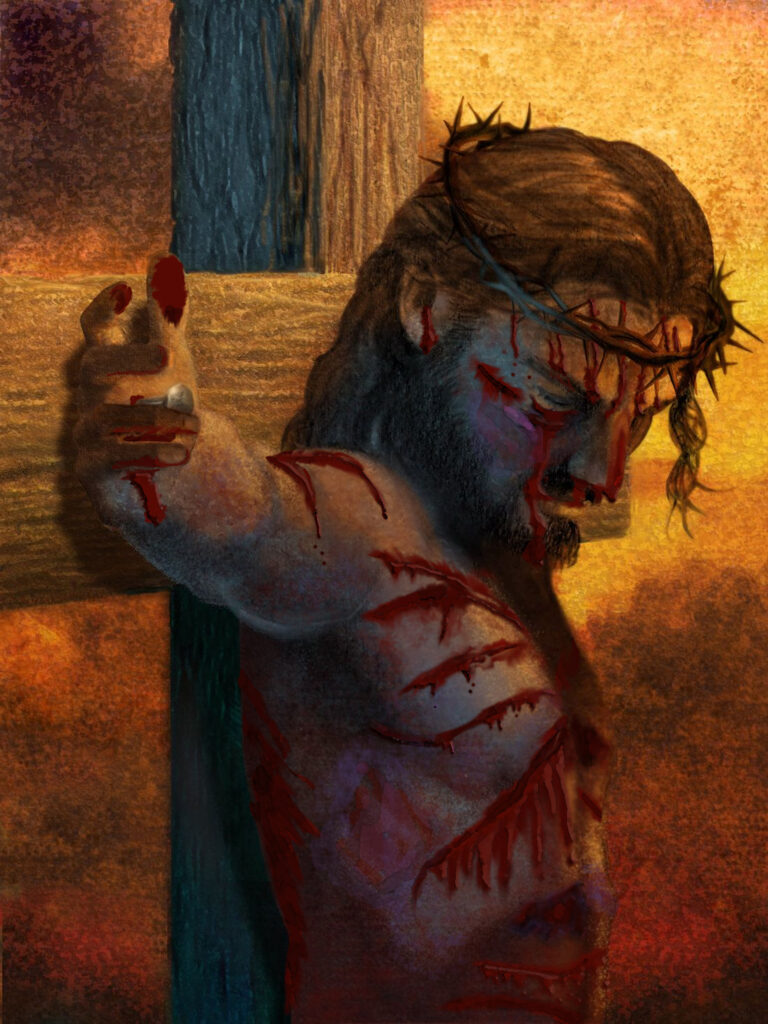
But Jesus didn’t die on the cross because you are a sinner. He died because you were a lost son or daughter whom He chose to dwell with in eternity. The purpose of His coming wasn’t simply to die for our sins. The cross doesn’t expose your sins; it removes them to expose your potential and value to God.

Jesus came, died on a cross, and rose from the dead. He conquered sin and death to reconcile you to Him—back to God. And if we reconcile with God, we will dwell with Him.

But this salvation plan comes with a warning: this is not an “Eternal Life Assurance Policy” or “Get Out of Hell Free” card. You can’t just sign it and forget it until you need it. God knows the sincerity of your heart. It’s not a “one and done” thing.

James 2:19 says, “You believe that God is one. You do well; the demons also believe, and shudder”. In other words, the demons believe God exists, but they shudder because they know their fate.

KNOW YOUR FATE, and if it leads to hell, change it before you perish physically. And don’t assume you’ll live out your life and can make that choice on your deathbed.

Nothing says, “I reject God’s ways and want my ways” more than someone who waits until the last second to decide. Do you think God will honor that decision? And a life lived saying you have accepted God and then living a lifestyle that proves you haven’t accepted Him is a close second.

God knows our hearts. He can tell whether a decision is sincere…

In 1 Samuel 16:7, God tells Samuel: “…God sees not as man sees, for man looks at the outward appearance, but the Lord looks at the heart.

1 Chronicles 28:9 says: “…Know the God of your father, and serve Him with a whole heart and a willing mind; for the Lord searches all hearts, and understands every intent of the thoughts. If you seek Him, He will let you find Him; but if you forsake Him, He will reject you forever.

Psalm 139:1–4 says: “O Lord, You have searched me and known me. You know when I sit down and when I rise up; You understand my thought from afar. You scrutinize my path and my lying down, and are intimately acquainted with all my ways. Even before there is a word on my tongue, Behold, O Lord, You know it all.

Jeremiah 17:10 says: “I, the Lord, search the heart, I test the mind, even to give to each man according to his ways, according to the results of his deeds.”

How do you know you’ll make it to a deathbed? You could die suddenly in a car accident or some other sudden way. Nobody knows when they will pass. Many NDE stories show that death can be sudden, before you have the chance to make a decision for Christ.

Go back to the section above where Jesus tells the story of Judgment Day. Some people will face judgment believing they are saved. But God will turn them away to hell because they didn’t obey His teachings.

Did you learn to love? Are you learning to love? Did you learn God’s love? Or did you embrace some “New Thought Relativist” idea?  Do you think it’s where love is relative to your circumstances? That kind of “love” is an abomination to God.

Slogans like “Love is Love” reflect some misconceptions about love. That slogan bespeaks the idea that validates a kind of love that is what homosexuals and transgenders feel for each other in a monogamous relationship. That’s not the kind of love God expects of us. God directly describes every sexual activity employed by the LGBT+ community as abominations. God intensely hates that. It says so in Scripture. There is no twisting it to mean what the slogan intends.

And LGBT+ people aren’t the only ones committing sexual sins God calls “abomination”. This group also includes adulterers, fornicators, and those who practice bestiality, pornography, masturbation, child molestation, and all other forms of perverse, profane sexual activity. 

These are not love, but rather perverted, profane, demented lusts. And they are all a ticket to hell if unrepented. The sinner must turn to godly ways for the duration of their physical life and renounce the sins. That’s repentance. That’s a true sign of a repentant, sincere heart.

God intended sex drive for procreation and nothing else. Notice that ALL sexual sins result in not reproducing, or they break the sacred institution of the marriage covenant. A godly relationship is important in the kingdom of God.

This isn’t simply wishful religious thinking. It comes directly from the Bible.

Those of us who have made a real, honest, sincere commitment to God obey his commandments.

In Philippians 2:12-13, Paul admonishes us, “So then, my beloved, just as you have always obeyed, not as in my presence only, but now much more in my absence, work out your salvation with fear and trembling; for it is God who is at work in you, both to will and to work for His good pleasure.

James the Apostle says in James 2:15-17, “If a brother or sister is poorly clothed and lacking in daily food, and one of you says to them, ‘Go in peace, be warmed and filled,’ without giving them the things needed for the body, what good is that?  So also faith by itself, if it does not have works, is dead.”

We have to put our faith into action. It ultimately boils down to a sincere relationship with God and our fellow humans. We must learn to “serve Him with a whole heart and a willing mind“.

So it behooves us to study the Scriptures, obey God’s commandments, and pray in secret with God, spending time getting to know Him and laying our hearts before Him.

And prayer takes place in our spirit with our minds and hearts engaged.

I began this post by describing how God puts a human being together.  I hope this helps readers understand how we communicate with God and why it matters.

Forgiveness

Consider the following parable Jesus taught about forgiveness. (Below, Scripture is italicized, and the emphasis in square brackets, bold font, and subtitles is added by us)…

Matthew 18:21-35

“ …Peter came and said to [Jesus], “Lord, how often shall my brother sin against me and I forgive him? Up to seven times?” Jesus *said to him, “I do not say to you, up to seven times, but up to seventy times seven.

An illustration of forgiveness – from The Chosen

Jesus continued by sharing the following parable with Peter…

“For this reason [forgiveness] the kingdom of heaven may be compared to a king who wished to settle accounts with his slaves.

The king settled accounts with a slave who owed much more than he could repay, but the king exercised forgiveness.

When he had begun to settle them, one who owed him ten thousand talents [an amount equivalent to $3.48 billion today] was brought to him.  But since he did not have the means to repay, his lord commanded him to be sold, along with his wife and children and all that he had, and repayment to be made. 

So the slave fell to the ground and prostrated himself before him, saying, ‘Have patience with me and I will repay you everything.’ And the lord of that slave felt compassion and released him and forgave him the debt

But that slave went out and found one of his fellow slaves who owed him a hundred denarii [around $622.75 today], and he seized him and began to choke him, saying, ‘Pay back what you owe.’ So his fellow slave fell to the ground and began to plead with him, saying, ‘Have patience with me and I will repay you.’ But he was unwilling and went and threw him in prison until he should pay back what was owed. 

So when his fellow slaves saw what had happened, they were deeply grieved and came and reported to their lord all that had happened. 

Then summoning him, his lord said to him, ‘You wicked slave, I forgave you all that debt because you pleaded with me. Should you not also have had mercy on your fellow slave, in the same way that I had mercy on you?’ 

And his lord, moved with anger, handed him over to the torturers until he should repay all that was owed him. 

My heavenly Father will also do the same to you, if each of you does not forgive his brother from your heart.”

We apologize to anyone reading this blog who is sensitive to the term “slave”. We intend no offense.

The concept of enslavement in Judeo-Christian Scriptures is different than our contemporary concept of it.

Forgiveness is essential to a healthy spiritual life.

Jesus’s teaching about enslavement does not focus on people groups but on spiritual principles. Jesus taught us that we are all enslaved to something or someone, and if we walk without forgiveness, we are a slave to that unforgiveness. We can’t be free.

In this parable, the king is God, and we are the slaves. We owe our lives for our sins and are enslaved to sin until we practice forgiveness. The debt is sin against the king [God] or sin against our “fellow slaves”, that is, our neighbors.

Jesus commanded us: “The foremost [commandment] is, ‘…You shall love the Lord your God with all your heart, and with all your soul, and with all your mind, and with all your strength.’  The second is this, ‘You shall love your neighbor as yourself.’ There is no other commandment greater than these.” (Mark 12:29-31)

Leviticus 19:18, Matthew 5:43, Matthew 19:19, Matthew 22:39, Mark 12:33, Luke 10:27, Romans 13:8, Romans 13:9, Romans 13:10, Galatians 5:14, and James 2:8 repeat this teaching. Its repetition shows the importance of the message. The commandment is so important that Jesus points out it leads to severe punishment if we don’t forgive. We practice forgiveness to love.

In Matthew 6:12, in the Lord’s Prayer, Jesus teaches us to pray: “Forgive us our debts, as we also have forgiven our debtors.” If we aren’t forgiving, we cannot truly love.

God forgives us and expects us to forgive all others.

Adam talks to God in the Garden of Eden

When God put the first man and woman on earth, He placed them in the Garden of Eden. He put every kind of plant in the garden and those for food.

And God commanded Adam and Eve not to eat of one tree in the garden. God called that tree the “Tree of the Knowledge of Good and Evil”.

Genesis 2:16-17 says,

The Lord God commanded the man, saying, From any tree of the garden you may eat freely; but from the tree of the knowledge of good and evil you shall not eat, for in the day that you eat from it you will surely die.

Adam and Eve had a good relationship with God, and they were companions of God. They enjoyed eternal life and fellowship with God until the serpent (the devil) got to Eve.

Genesis 3:1-7

Now the serpent [devil] was more crafty than any beast of the field which the Lord God had made. And he said to the woman, “Indeed, has God said, ‘You shall not eat from any tree of the garden’?”  The woman said to the serpent, “From the fruit of the trees of the garden we may eat; but from the fruit of the tree which is in the middle of the garden, God has said, ‘You shall not eat from it or touch it, or you will die.’” 

Adam and Eve being tempted to eat the fruit of the Tree of Knowledge of Good and Evil.

The serpent said to the woman, “You surely will not die!  For God knows that in the day you eat from it your eyes will be opened, and you will be like God, knowing good and evil.”   

Notice that the devil got the woman to overthink and over-analyze the situation. This is the tactic the devil uses most often with people. “Oh, God didn’t mean that…are you sure He said that? He just doesn’t want you to be like Him!”

When the woman saw that the tree was good for food, and that it was a delight to the eyes, and that the tree was desirable to make one wise, she took from its fruit and ate; and she gave also to her husband with her, and he ate.  Then the eyes of both of them were opened, and they knew that they were naked; and they sewed fig leaves together and made themselves loin coverings.

God told Adam and Eve that they would surely die the day they ate from the tree. They obviously didn’t fall over dead after eating the fruit. They actually lived on for a long time after that. God’s message meant something else. The death God spoke of was spiritual. Spiritual death is “separation from God“. The curse God pronounced happened because they disobeyed God, and that began at the point they sinned.

Then to Adam He said, “Because you have listened to the voice of your wife, and have eaten from the tree about which I commanded you, saying, ‘You shall not eat from it’;

Cursed is the ground because of you; In toil you will eat of it all the days of your life.
“Both thorns and thistles it shall grow for you; and you will eat the plants of the field;
By the sweat of your face You will eat bread, till you return to the ground,
Because from it you were taken; for you are dust, and to dust you shall return.”

(Genesis 3:17-19)

They died spiritually. Humanity became separated from God, and our nature changed.

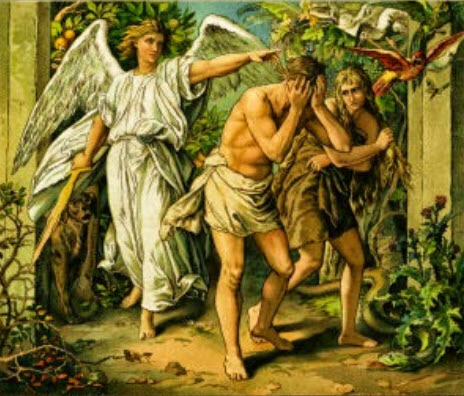
Then, God banished them from the Garden of Eden. “…He drove the man out; and at the east of the garden of Eden He stationed the cherubim and the flaming sword which turned every direction to guard the way to the tree of life.” (Genesis 3:24).

All people descended from Adam and Eve, and consequently, we are all born into sin. We refer to this as “the fallen state”. And after that point, every human being has died. We went from complete harmony with God to being alienated from God.

God is love (1 John 4:8). He created us in His image (Genesis 1:27). This means we were the definition of love until we sinned, and our nature stopped being like God’s. We needed reconciled back to God. Because of sin, we no longer had a connection with God. We needed God’s forgiveness.

We don’t know much about how God dealt with sin from Adam to Moses. God provided details about important events that happened before Moses. Jewish Scripture records these events. We have some clues from stories about Abraham, Noah, Job, and others. There is a connection to God throughout the stories about these people. However, most people perished in sin in those days because there was no mechanism for forgiveness.

But we know that God loves all of His creation and wants us all to come to repentance. 2 Peter 3:9 says, “The Lord is not slow about His promise, as some count slowness, but is patient toward you, not wishing for any to perish but for all to come to repentance.” We believe, in that time between Abraham and Moses, that God made a way for people to cover their sins and have some semblance of a relationship with Him.

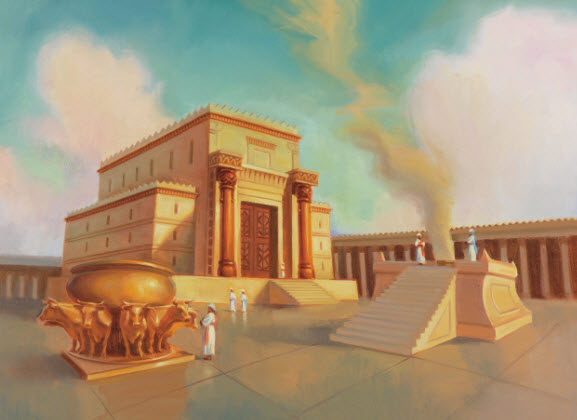
Sacrifice for the atonement of sins in the Jewish Temple at Jerusalem.  Atonement was not like forgiveness.

Then Moses came, and a formal process was given to cover the sins of the people.

But covering sin is a different thing than removing sin.

When people followed this process, God forgave their sins. But it didn’t reconcile them back to God. Scripture tells us that “all have sinned and fall short of the glory of God” (Romans 3:23).

We all have a need for forgiveness.

The righteousness of God has been manifested, being witnessed by the Law and the Prophets [the Jewish Scriptures] … through faith in Jesus Christ for all those who believe. [We] are justified as a gift by [God’s] grace through the redemption [through] Christ Jesus; whom God displayed publicly as a [payment] in His blood through faith.”  (Romans 3:21-24).

This could only be accomplished by a human being. “Just as through one man [Adam] sin entered into the world, and death through sin, and so death spread to all men, because all sinneddeath reigned from Adam until Moses, even over those who had not sinned in the likeness of the offense of Adam, who is a type of Him who was to come...” [Jesus] (Romans 5:12,14). “If by the transgression of the one the many died, much more did the grace of God and the gift by the grace of the one Man, Jesus Christ, abound to the many. ” (Romans 5:15).

Jesus referred to Himself as “the Son of man” to emphasize that a man had to pay the price for sin to reconcile us to God.

This is why Jesus was sent to accomplish the reconciliation for all who receive it. And why Jesus (God) had to be born into a human body. Remember, the sacrifice for sin had to be an unblemished life, that is, without sin. Only Jesus was without sin. No other human could have done it.

God's solution was to come to our temporary physical universe as a man to forgive our sins, paying the price with His life so we could have forgiveness and be reconciled to Him.

The gift [Jesus paying the penalty for our sin with His life] is not like that which came through the one who sinned [Adam, and all people since Adam]; for on the one hand the judgment arose from one transgression resulting in condemnation, but on the other hand the free gift arose from many transgressions resulting in justification. For if by the transgression of the one, death reigned through [people], much more those who receive the abundance of grace and of the gift of righteousness will reign in life through the One, Jesus Christ.” (Romans 5:15-17).

This is Paul’s first-century language (translated from another language) telling us that God made it possible, through faith that Jesus Christ paid the cost of sin, for us to be reconciled back to God. God forgave it all so we could enjoy a reconciled life with Him once again!

  • Iniquity = gross injustice: wickedness. A wicked act or thing: sin
  • Transgression = infringement or violation of a law, command, or duty
  • Sin = offense against religious or moral law
  • Tresspass = an unlawful act committed on the person, property, or rights of another. A violation of moral ethics.

These all amount to disobedience to God and wrong treatment of our neighbors, which goes against God and His nature. To be right with God, we need forgiveness for anything we do that fits these definitions.

“…God did not send the Son into the world to judge the world, but that the world might be saved through Him.” (John 3:17).

Salvation (and forgiveness) is a free gift from God. Not a single thing can be done to earn salvation. Asking forgiveness is an act of repentance for the sins we have committed. Being forgiven is a gift that God gives us in response to our repentance. It must be a sincere motive in our hearts and minds for God to accept it as repentance.

To receive this free gift of forgiveness and salvation, we have to believe that we have sinned against God. To believe that, you have to know God and understand his nature. If God is love, there is no evil in Him.

Sin is, therefore, anything that goes against God’s perfect, loving nature.

What is God’s nature, then?

Habakkuk 1:13 says, “Your eyes are too pure to look on evil; you cannot tolerate wrongdoing…”.

Adam and Eve being expelled from the Garden of Eden so they would not eat from the Tree of Life and be like God.  They left in a state of needing forgiveness.

God created us to be like Him, and only because of sin have we become anything else. We are born into sin, and we need God’s forgiveness to escape sin. Thank God that He sent His only begotten Son to give us that escape route from sin! And it is available to all who believe.

Because God is pure, sin and a sinful nature do not belong in Heaven. The Garden of Eden was a type and shadow of heaven.

Judgment day

In our fallen state, we cannot live in heaven or be reconciled to God. And Judgment Day is about reviewing our lives in the physical universe to determine if we accept God or reject Him. How we live this physical life is our testimony. And our testimony is the only thing we take with us when we pass from this life.

Even if you have lived your life to this point devoid of God, there is still hope! The beauty of repentance is that you have salvation whenever you change your heart and mind and commit to God. But it has to be genuine. Turning to God and then turning back away again is not sincerity or genuineness of heart.

Jesus said, “…No one, after putting his hand to the plow and looking back, is fit for the kingdom of God.

Just make sure your decision to follow God is genuine and fully committed to Jesus.

God is love

“…God is love” (1 John 4:8). Paul describes Love in 1 Corinthians 13:

…Love is patient, love is kind and is not jealous; love does not brag and is not arrogant, does not act unbecomingly; it does not seek its own, is not provoked, does not take into account a wrong suffered, does not rejoice in unrighteousness, but rejoices with the truth; bears all things, believes all things, hopes all things, endures all things…Love never fails…

Forgiveness is Love. Love is something we all seek. We are all built to love. When someone returns our love with hate, we feel it.

We were created in God’s image.

When practicing Love, we don’t return hate for hate. Jesus responded in love even when He was hated.

Love is Forgiveness.

We traded God’s image for the devil’s when we sinned. We have to repent of our self-centeredness and take on God’s image again.

We have descriptions of heaven, but we can only render from imagination what it is like.

God’s presence permeates heaven. No corner or recess in heaven is void of God’s presence. Heaven is God’s dwelling place. If He doesn’t want sin in his dwelling place, who can argue with that?

It would be as foolish as what the devil did that got him kicked out of heaven. Without forgiveness, we don’t belong in heaven and can’t get in.

Once we understand that we are eternal beings, everyone wants to spend eternity in the best place. The best place is in heaven with God.

We are eternal beings that temporarily inhabit a physical body, and after this physical body perishes, we move to higher dimensions and live eternally there. James 2:26 says: “Just as the body without the spirit is dead, so also faith without works is dead“.

We are composed of Body, Soul, and Spirit according to Scripture. A Full sense of our composition comes from studying all of Scripture. This physical body is a temporary dwelling place for our spirits. Our spirits are eternal.

This is eternal life, that they may know You, the only true God, and Jesus Christ whom You have sent.” (John 17:3).

And that is exactly what God the Father sent Jesus to be a man to do. He sent Jesus to pay the price for our sins that alienated us from God. And that makes it possible for us to be reconciled to God once again so we can know God.

Jesus said: “…Everyone who has left houses or brothers or sisters or father or mother or children or farms for My name’s sake, will receive many times as much, and will inherit eternal life.” (Matthew 19:29).

What does it mean to follow Jesus? All of these other things were adjustments to behavior and attitude.

Relationship with Jesus means closeness with Him.

…Jesus said to His disciples, “If anyone wishes to come after Me, he must deny himself, and take up his cross and follow Me…” (Matthew 16:24).

Following Jesus is a recurring theme in Christian Scripture. He asked all of the disciples to follow Him. In Matthew 16:24, we see the process of following Him.

Deny yourself

We first have to deny ourselves. Remember, we are born into sin and alienated from God. We grow up not knowing God, and we put false identity on. It’s a facade we carry around, telling ourselves, “This is who I am”. Those who aren’t called when they are small take on this identity. But God created us with a purpose—to reflect His image and to give Him glory in our identity. When we deny ourselves, we are giving up this old identity and surrendering it and our lives to God.

take up your cross
Take up your cross and follow Jesus.  That doesn't mean go on a hike with Him, it means do what He does.

The cross is a symbol of execution. In a sense, Jesus was foretelling His own death by choosing to speak of the cross. But He was indicating to His followers how serious and final a commitment is to follow Him. It’s transformational. It’s life-changing. It meant complete and permanent denial of the old self. This isn’t something you can give lip service to and later go back to the old way of life and thinking.

Many American believers, and consequently believers worldwide who pattern after Americans, come to be “Christians” by praying what is known as “The Sinner’s Prayer”, made famous at Billy Graham Crusades. The Sinner’s Prayer is part of the process but is just the beginning. And actually, the Sinner’s Prayer is pretty young. It is far younger than Christianity.

Scripture doesn’t call out the “Sinner’s Prayer”. It is a device created to quickly get many people (at a Crusade, Revival, or church service) to give their lives to God. The disciples and early Christians would call for people to “repent and be baptized”.

…Peter said to them, “Repent, and each of you be baptized in the name of Jesus Christ for the forgiveness of your sins; and you will receive the gift of the Holy Spirit…

Billy Graham was a good man and a great evangelist. His heart was in the right place when he endeavored to conduct his “Crusades for Christ”. He wanted people to be saved and not perish in their sins, experiencing forgiveness, which all Christians are commissioned to do.

However, when Billy made a call for people to receive forgiveness and deny themselves, take up their cross, and follow Jesus (an “Alter Call”), he would ask things like, “If you were to die in a car accident on the way home tonight, do you know where you would spend eternity?”

This is very thought-provoking, but it focuses on the person rather than following Jesus. It essentially left the door open for the repentant sinner to look at salvation as a kind of “Eternal Life Assurance Policy” rather than total surrender to Jesus and commitment to follow Him and His ways.

Praying the sinner's prayer isn't the same thing as following Jesus.

Jesus spoke about seeking “things” rather than a relationship with Him. In Matthew 6:31-34, Jesus said: “…Do not worry then, saying, ‘What will we eat?’ or ‘What will we drink?’ or ‘What will we wear for clothing?’  For the [non-believers] eagerly seek all these things; for your heavenly Father knows that you need all these things.  But seek His kingdom and righteousness first, and all these things will be added to you…

Many Christians have viewed Christianity as a kind of Christian Social Club exclusive to its members. Its members having a certificate of membership in their “Eternal Life Assurance Policies”. They skip the part where Jesus says, “Follow me.” Or worse, they believe they are following Him because they are church members.

Those on the outside who are seeking God see this hypocritical behavior and don’t want to be a part of it. Instead of seeing Jesus being reflected, they see self-seeking people who belong to a religious club that excludes them.

Praying for the sick is one way we do what Jesus did.

To follow Jesus means to do what Jesus does. Jesus laid down His life for us. He practices love at every point of decision. To follow Jesus means we do what Jesus gave us as a living example.

To do that, we have to study Jesus, and there are two ways we can study Him: 1) through the Scripture journaled for us and 2) by becoming sensitive to the leading of the Holy Spirit. Remember, Peter, an eyewitness to Jesus, said we were to repent and be baptized, and we would receive the gift of the Holy Spirit.

Many churches today barely recognize the Holy Spirit, including the Christian denomination that recognizes the importance of water baptism—the Baptists. Yet the Holy Spirit has been the inspiration for the Old and New Testament writings, and even which of the many writings about God throughout Christian church history were included in the compilation of Scriptures. And the Holy Spirit took the place of Jesus walking through life with each of us.

Jesus said, “I tell you the truth, it is to your advantage that I go away; for if I do not go away, the Helper will not come to you; but if I go, I will send Him to you.” Jesus said this as He was preparing to ascend to heaven after His resurrection. This was not something intended only for those who were on earth when Jesus was, but for all who believe from that point going forward.

Role of the Holy spirit in our lives

…The Helper, the Holy Spirit, whom the Father will send in My name, He will teach you all things, and bring to your remembrance all that I said to you…” Because Jesus said this, we recognize that the Holy Spirit plays a central role in our ability to follow Jesus. We, therefore, must develop ears to hear and sensitivity toward the Holy Spirit.

God's Holy Spirit dwells within us if we have forgiveness.

Paul said: “…Although you were formerly alienated and hostile in mind, engaged in evil deeds, yet He has now reconciled you in His fleshly body through death, in order to present you before Him holy and blameless and beyond reproach—if indeed you continue in the faith firmly established and steadfast, and not moved away from the hope of the gospel that you have heard, which was proclaimed in all creation under heaven…” (Colossians 1:21-22).

The Holy Spirit has the same role for us today that Jesus had with those He walked the earth with. This is how we stay established and steadfast in the faith.

We walk believing Jesus has reconciled us and presents us to the Father as “holy, blameless, and above reproach”. From the moment we first believe, until the day God calls us home, we view ourselves in this way, and we can wake up each morning believing this is who we are. It motivates us to avoid sinful behavior and to seek conduct that reflects and glorifies Jesus.

Jesus’s mission was to bring us the opportunity for forgiveness so that we could be reconciled to Him. We need reconciliation to have a relationship with God. Jesus told us to practice forgiveness with others because it was one way we love others. Forgiveness is a choice we make with eternal ramifications.

It is impossible to enter heaven and have a reconciled relationship with God unless we forgive.

Did God Create Evil?

It seems that perennially, with every new generation coming of age (becoming adults responsible for running civilization), this question surfaces: Did God create evil?

Bad things happen in this life.  Some are evil, and God seems unwilling to stop them.  This makes us wonder, "Did God create evil?"

The uninformed thought goes, “If God created evil, it must be a part of Him, and when He says He is all good, He is lying, and He is evil”.

It’s a terrifying prospect that the one who created all things might be evil. But if that were the case, we would see more of that, and there would be no good.

There is a perennial anecdote that goes with this question, which we think illustrates the answer about whether God is evil or not:

This story is often attributed to Albert Einstein’s experience with a professor. We find no concrete evidence that this is true, but the story nonetheless makes valid points concerning evil, good, and God.

Did God create evil? It seems that evil is the absence of good. But God created a physical universe that is rife with the absence of good. Why would God create a world like that? We will answer below.

Evil is simply the absence of good (or God). But why would that underlie our environment? Why would God create an environment in which evil is at its base? Perhaps a better observation is that God is good, and He overpowers the possibility of evil.

A man troubled by the question "did God create evil"

The professor in this story made several assumptions based on his own biases. Evil is not a created thing, so it doesn’t follow that God created evil.

The professor in the story above assumed that there is a principle that says our behavior defines who we are, which is incorrect.

Actually, our behavior only defines the pattern of choices we have made. While there is merit to the idea that our choices are guided by what is in our hearts and minds, the fact that we can change our minds proves that our behavior choices don’t define who we are. So much of our behavior choice depends on our environment and the external inputs influencing decisions.

We may want to make different choices than we do under given circumstances, but the circumstances preclude making a better choice. Or, due to inexperience, we may make a poor choice that we later regret and wish we had made a different choice.

Experience brings wisdom, and both bring maturity and, thus, better choices. This is not always the case. Some people never develop maturity.

It's a common rallying cry today "Stay young!" as if thinking like a young person can prevent aging, or somehow, magically keep you youthful and vital.  This can distract us from learning important lessons in life.  Bad choices in life can lead to the abscence of God, which is the definition of evil.  It isn't a created thing.

An “always stay young” philosophy can harm a person’s maturity. It’s good to stay nimble and vibrant (and all the good, productive, and valuable things that embody youth), but it is a detriment when you lack the maturity to temper those things.

The fact that some of our choices bother us indicates what we are genuinely like underneath. Our choices don’t define us, but what lies underneath, deep in our hearts and minds—the part of us that isn’t easily exposed or understood (to others and ourselves) defines us. If we are drawn toward evil, that may define us more than making evil choices.

We are more drawn to God if we prefer goodness, love, and light. And aren’t these the things we all universally seek? The street minister Lonnie Frisbee once observed, “People are looking for all of the right things in all the wrong places” (referring to the fact that God supplies all of these things, not “drugs, sex, and rock-n-roll”).

We see evil in the world because people sometimes make bad choices. Scripture tells us it has been that way since Adam and Eve committed the original sin. Does that mean people are all evil? We have to make that conclusion if we make the wrong assumption, like the professor in the anecdote above. But there is a better way to look at this.

The professor in our story assumed that God created evil. But God created people with free will and the ability to make their own decisions. People make decisions to be evil.

God is faithful to Himself; He is all good and perfect love.

There is a reason God set up our environment where the potential for evil exists. It’s linked to why God chose to remain invisible to us—unless we seek Him. See this link for a full explanation.

As the anecdote asserts, Evil is the absence of God. People without God in their hearts and minds commit evil acts, so yes, evil exists, but God neither created it nor is He a part of evil. He merely set up the physical universe so it was possible for people to make evil choices.

You may want to know why God made it possible for evil choices to be made in our environment. That’s a good, honest question.

For those having trouble imagining that we are eternal beings from a higher dimension temporarily housed in physical bodies in this temporal situation, we will ask you to suspend disbelief for discussion so that you might understand this perspective. Just pretend this is a fact for now.

Did God create evil? No. Did He allow evil to exist? No. Evil is the absence of God. People can make the choice to have God absent in their lives. In such a case, there is nothing governing their choices or their consceince except their moral conscience (or the absencse of a moral conscience). In a case like that, we can make decisions that lead to evil outcomes. God didn’t create that evil, but He allowed for it by creating a universe we live in where people make up their own minds how to behave. When God is not present, sometimes evil is the outcome.

Now, imagine that we are temporarily living in this physical universe for the sole purpose of building a testimony about our thoughts and inner feelings guided by our mind and heart. God wouldn’t want us influenced by His presence, so He allowed us to make our own choices without being directly involved with us by default.

It is easy to be unaware of God’s presence. It sets up an environment where people always make candid choices.

If our testimony were to be used to answer the question, “Why should I allow you to dwell in the Kingdom of Heaven?” we can readily see that how we lived our lives reveals the absolute truth in our hearts and minds and exposes the answer to that question.

Suppose we take the testimony of how we lived our lives with us when we die, and then we face God on Judgment Day, where God judges us based on our testimony (to answer the question above). Since we made our own choices, our lives testify to whether or not we accepted God.

It’s an ingenious way for God to demonstrate to us what our hearts and minds are and whether we want God in our lives for eternity. God knew us before we were even born so that the judgment process would be for our benefit (or our detriment, depending on how we lived our lives). It’s so we can see who we are through how we choose to live our physical lives; there is no denying the truth. There is no hiding from the facts.

Whether we choose God or not is essential where eternity is concerned. Choosing God means we will dwell with Him forever. Choosing evil means we spend eternity (a very long time) in outer darkness where, according to Scripture, there is wailing and gnashing of teeth. We associate those things with resentment and despondent sorrow. And that describes a place where those in it understand they made a very bad choice.

God, being the opposite of evil, doesn’t want evil in His Kingdom. That seems reasonable. He doesn’t want anyone to make the choice for evil, but He gives us each the opportunity to make the choices we will make.

The trouble is, people make choices they will regret—some permanent. Scripture tells us that God’s people are perishing because of their lack of knowledge. It goes on to say that He gave that knowledge to them but they rejected it.

God didn’t create evil. It isn’t in His nature. Evil exists because we make bad choices and sin. This is just a spiritual reality. God wants companionship—family. It’s why He created us. God opposes evil; it’s not even in His nature. If we want to dwell with God eternally, we can’t have an evil nature. With God, all things are possible—including changing our nature.

God is good. Since He didn’t create evil, it is not a part of who He is.

But God doesn’t want companionship with puppets or beings who are slaved to His will. He wants it to be of our own volition. That’s why we have free will and the independent ability to make our own choices.

Evil is within the possible choices for human (and angel) behavior. This means those things must be bred out of us to enjoy God’s good and love for eternity.

If you would like to know how to ensure that your life is on track and that you are close to God, visit this page.


Faith

It takes faith to believe in an invisible God. It also takes faith to believe that the physical universe and all that exists came out of nothing without intelligent design—without God. More faith is needed to believe something came out of nothing than it does to believe some intelligence influenced our creation.

Nobody has witnessed our origins throughout human history, and we all believe what we believe in faith. Just because we believe an “origin story” doesn’t make it fact.

Stephen Hawking's faith was that there is no God who created the universe.

A scientist named Stephen Hawkings, shortly before he died from Lou Gehrig’s disease (ALS), told the world that he could prove the existence of the physical universe without including God.

There might be a mechanism that created the physical universe without intelligent design, but Hawking’s ideas are just an unprovable theory.

It is possible that Stephen Hawking was bitter at having this disease and blocked out the idea that a God who is supposed to be all-loving and kind would inflict Him this way—he couldn’t accept that a God that cruel could exist and be described as “all loving”. He threw out the idea of a loving God because he started with a false premise—that God inflicted him.

It probably wasn’t God who afflicted him. After all, things also happen because of sin, evil, and human will—not because God inflicts us. Did you know that, according to Judeo-Christian doctrine, sin can actually mutate genes?

The point is that we must be on guard that we don’t miss the truth because of bitterness and misplaced resentment.

Hawking asserted that gravity existed in the beginning and pulled together “matter clouds” to create the Big Bang. However, he could never explain where the “matter clouds” or gravity came from. Without the use of a creator, how do you explain the existence of these things? After all, the matter clouds contained the code for everything in the physical universe, and gravity somehow instigated the release of that power. It’s unfathomable to imagine those things were just there without help of some kind.

When asked, “What happened to put these things in space?” He said they were at the beginning of time, and there was no “before that”.

Where did the “matter clouds” and gravity come from? Why did they “just exist”? Why not more than that? Did no one put them there? Suppose someone from a higher dimension outside the physical universe’s timeline put them there. Why does the physical universe seem to have intelligent design?

He never attempted to explain how the physical universe could interface with higher dimensions, which is also a science.

One of God’s Hebrew names is El Olam, which means “The everlasting God without beginning or end“. That means He existed outside of physical time. Science only examines what has happened inside of the physical timeline. What about things outside of the physical universe?

Can you see how Stephen Hawking heavily relied on faith? There’s nothing wrong with believing things on faith. We all rely on faith. But some things can distract us to the point of missing the important things.

Another atheist named Richard Dawkins once said, “Prove the existence of God“. And, of course, the reply was, “Prove God doesn’t exist”.

The point is that nobody can prove beyond a doubt their ideas about what did and didn’t happen at the beginning of our origins.

Many scholarly people have found God by attempting to disprove God’s existence. (Explore Josh McDowell, Nicky Gumble, Jim Wallace, and Lee Strobble.)

Christopher Hitchens, well known atheist who wrote a book called, “God Is Not Great: How Religion Poisons Everything“, is said to have had a deathbed conversion to Christianity. Some leftwing media outlets dispute this claim, but first-hand, eye-witness accounts suggest that he did convert in the end.

It takes faith to believe something one has not witnessed firsthand. Nobody witnessed the beginnings of the universe.

So, what is faith?

According to the Christian Bible, “…Faith is the substance of things hoped for, [and] the evidence of things not seen” (Hebrews 11:1). Substance is “practical importance”, and evidence is “something that furnishes proof—testimony“.

So, “Faith is the practical importance of things hoped for, and the testimony of things not seen“.

The Christian Bible tells us, “…Without faith it is impossible to please [God], for he who comes to God must believe that He is and that He is a rewarder of those who seek Him.” (Hebrews 11:6)

So God can be sought! This sounds like God invites us to seek Him! He chooses to remain invisible to people in general, but He wants us to seek Him—and find Him! What better way to demonstrate devotion to God?

In a previous blog post below, we showed how an invisible God can exist. Since He is invisible, it makes sense that He is ordinarily not seen—unless we look for Him.

We find a promise in the Judeo-Christian Scriptures that “You will seek Me and find Me when you search for Me with all your heart” (Jeremiah 29:13). If we search for God in faith and belief, He will let Himself be found!

We would postulate that Richard Dawkins doesn’t find God because he doesn’t seek God in faith. Rather he rejects the idea of God out-of-hand. It’s sad. But you can seek God!

If this is all new to you, then you have something new to consider! Science offers some comprehensive ideas that seem to make sense, though they don’t consider all aspects of science. Those aspects explain an invisible God. Science doesn’t cover why the physical universe has so much intelligence built into it. A creator does.

Science cannot even study higher universes so how can science that incomplete be enough to omit possible eternal life?

Consider what Christian Scripture says about God: “He who believes in [God] is not judged; he who does not believe has been judged already, because he has not believed in the name of the only begotten Son of God. [Jesus]

Judgment refers to what happens at the end of physical life when our spirits are resurrected and stand before God to account for our lives. If we believe in God, we will dwell with God; if we don’t, we will dwell for all of eternity in a dark place where there is wailing and gnashing of teeth—not because God punishes us for not believing in Him, but because in eternity, God is the source of light, and God is Love, which translates into all kinds of benefits like peace, joy, contentment, etc.

Knowing that those condemned are locked out of an eternity like that is what causes some to mournfully cry, and others to get so angry they shake their fist at God and gnash their teeth.

Have you ever felt an inner compulsion to investigate something? We’re betting you did, and that’s how you found this website. We believe God is speaking to you through your inner compulsion—not that you found this website, but that you felt an inner urge to seek information about life’s questions. Keep listening to those inner compulsions and develop sensitivity to them. If they lead to God, you are listening to God.

If they lead you to something evil, it isn’t God because God is good in nature.

We believe we have sought God enough to find Him, so we put together this website. You have to discern whether this is truth for yourself. We only ask that you consider our information and see if it is true.


Can You Believe In An Invisible God?

Home

Some people only trust what they can see, touch, smell, hear, and taste. These are all physical attributes of a physical universe. But what if there is more out there? Suppose that higher dimensions exist and life exists in them, but we don’t have the ability to sense them. Can God be invisible because He exists in higher dimensions? Can you believe in an invisible God?

If you could imagine a world in which everyone was flat and could not perceive up and down, we know there is a whole world of things that exist that aren’t on the plane that the flat people lived on.

Now, imagine the opposite. Suppose we are like the flat people living on a plane, only we have three dimensions. Someone who exists in higher dimensions could actively be doing things outside our ability to perceive them. It’s the same concept, only stepping up the number of dimensions. It’s mind-boggling for us to even try to envision higher dimensions. But suppose they are out there, and beings exist in them.

They are invisible to us, but they are there just like we are invisible to flat people on a plane, but we are here.

In this way, it is possible to believe in an invisible God.

We will explore this question on this website and provide evidence that it is possible and food for thought.

Check out the following pages on our site as a primer:
Why Is God Invisible?
4D Encounters in a 3D World
Why Did God Create Us in a Dimension He Doesn’t Live In?

Happy exploring!


Have you ever thought about our origins, how you got here?

The vast size of earth hides the size and complexity of its inhabitants.

Aside from the obvious that you were born into this, go back further and consider how “this” got here for you to be born into it and what had to happen for you even to be born. It’s pretty miraculous, don’t you think? What are our origins?

Look at the image of Earth from space above. Can you see people on the surface? You can’t because of the scale of the image and the distance from the Earth’s surface where this picture was taken. People are too small to see with the naked eye. Space is very vast. When you consider the size of the physical universe, we are just one tiny part of it. Yet our lives are so complex.

It’s mind-boggling to contemplate what it took for all of this to form. The size of the universe alone is staggering. Science tells us that the universe has intelligent design, so a creator had to create it. It’s mystifying to think of the greatness of whoever created it.

Science says we got here through the “Big Bang“. Religion says God created us. What are our true origins?

Suppose God is a fairy tale and what science postulates is right. Statistically, that leaves us with a fantastic coincidence and random, accidental happenstance. It takes more faith to believe all of this happened out of nothing than to accept an intelligent, invisible life form we call God created it. Either idea takes faith to believe in it.

The Big Bang postulates it all randomly happened due to the right circumstances.

But suppose both are right. What if God created it all on a cosmic drafting table and then used the Big Bang to set it into motion?

Do our origins come from the Big Bang?  Even if they do, Science tells us that there is intelligence to the universe and someone created it.

Consider all of the life on earth. Think about how it all has to work together for life to exist. Many scientists agree that some intelligence had to be behind the creation of the physical universe. There is something or someone who thought it through and came up with the intelligent design behind it all.

Yet, when you think about it, there is no physical evidence to support the idea of an invisible force or being that thought all this up…or is there?

Explore our thoughts and ideas about the physical evidence leading to the feasibility of an invisible creator. We get lots of exposure to science in school, so why not explore the question, “Why is God invisible?